Family Court Reform measures come into force


During a World Economic Forum in Davos, Switzerland, corporate chief executives predicted that advances in AI would enable “productivity on steroids”. This was after the consulting firm McKinsey & Co. declared in a 2023 report that “Generative AI is poised to unleash the next wave of productivity,” adding value roughly the size of the UK’s economy to global growth each year.
Certainly, these positive effects would be welcome in the EU ̶ on whatever timeline they arrive. But what the EU should ponder is that the United States is experiencing a productivity boom right now, and not because of AI. In fact, worker productivity across the Atlantic is growing at the fastest pace since the decade-long surge of the 1990s ̶ what is still the highest productivity growth rate in 50 years.
This is surprising because only about 5 percent of businesses in the US use artificial intelligence to produce goods and services right now. So what is driving America’s productivity pop? It seems that what accounts for it is a surge in new business creation across the country.
It is well documented that entrepreneurship is the lifeblood of productivity growth because these companies bring innovations to the market and drive competition, which in turn forces larger, incumbent companies to become more productive or lose market share.
In 2023, the US Census Bureau counted nearly 5.5 million applications for new businesses, more than in any year since it began tracking this data two decades ago. This rising number of Americans striking out on their own comes after an extended decline in US business dynamism.
By comparison, using the latest statistics available for both, in 2020 new business registrations in the EU totalled just over one million (224.8 new businesses per 100,000 population) while there were 4.4 million in the USA (1,335 new business per 100,000 population).
Looking, then, at some EU statistics, the index of quarterly changes in new registrations shows that many member states has been struggling. Thus, the annual rate of change in the index between 2018-2023 shows drops of 8.14% and 5.51% in Ireland and Malta respectively, while the situation has worsened post-Covid with drops of 14.7% and 8.3% in Ireland and Malta respectively.

Increased productivity largely determines the nation’s long-term economic growth path. Governments can stimulate the economy with increased spending, but that boost is often temporary, and risks stoking inflation. Central banks can boost growth with lower interest rates but must eventually raise them again to avoid overheating the economy.
On the other hand, workers becoming more productive, generating more output without needing more time or more resources, fosters sustainable growth. Employers can reinvest profits in expanding the business or raise employee wages without raising prices and fuelling inflation.
It’s no coincidence that the productivity boom of the 1990s, driven by the widespread adoption of the internet, was accompanied by low unemployment and the fastest inflation-adjusted earnings growth in 40 years.
So what’s been happening to productivity in the EU? The chart below compares the real GDP per hour worked in Malta vis-à-vis the EU average. As can be noted, over two decades Malta’s productivity was considerably below the EU’s, the Eurozone’s, Germany’s, and Finland’s but the gap has closed and in 2023 Malta surpassed them all.
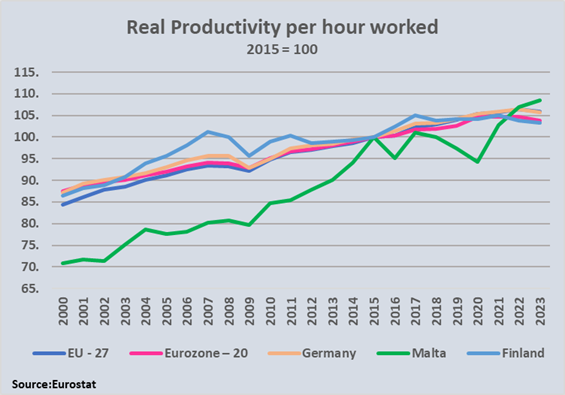
Over the past decade Malta has increasingly moved away from industry towards the services sector where, with some notable exceptions such as financial services and iGaming, the average value added per worker is relatively lower. The nature of the jobs performed by the labour force also matters, in that the more elementary the job, the lower the value-added, and hence the lower the productivity of that job.
There is no doubt that a substantial portion of the growth in GDP in recent years has been driven by a higher population, not by any significant improvements in labour productivity and value added. We are risking repeating the mistakes committed over the years in the tourism sector, where the be-all and end-all of success has been the count of tourist arrivals, rather than expenditure per head. In the economy at large, growth is being driven by the number of employees, not by their productivity and value added.
Apart from the reasons mentioned before, increased labour productivity also allows Maltese firms to compete successfully on the international market, and in the longer run translates to higher wages and better working conditions for employees. Finally, increased productivity also yields higher tax revenues for the government.
At the firm level, labour productivity improvements can be attained by, for instance, investing in digital tools, rolling out employee training programmes, process redesign, or creating a culture conducive to high performance. Often enough, this can be done by simple and cost-effective steps such as small investments in technology and processes.
Here, I need to mention that, together with labour, capital is the other key input factor for the production process. Examining EU asset stocks, we find some interesting aspects for different countries over the period 2010-2019, also comparing it to 2020 and to 2021.
A cross-country comparison of a proxy for capital productivity ̶ measured as real gross value added per unit of net fixed assets ̶ reveals that, analogous to the labour productivity indicator, this indicator shows the relation between the units of output (real gross value added) produced and one unit of capital stock (input).

Over the period 2010-2019, the annual average growth rate of gross value added per unit of net fixed assets varied considerably across countries. A large majority of member states recorded positive growth, in other words, on average, output grew faster than capital input. The highest growth was registered by Malta (+3.8 %), followed by Latvia (+2.9 %). On the other hand, gross value added per unit of net fixed assets declined for a few countries, notably Ireland (-2.7 %) and Croatia (-1.1 %).
Further insights can be gained by looking at the capital-labour ratio, making it possible to analyse the intensity of the use of fixed assets in relation to the use of labour input. Differences across countries are also related to different types of industry structure and technologies, which both imply different degrees of capital intensity compared with labour intensity.

Over time, changes in the aggregate capital-to-labour ratio are basically driven by capital accumulation for most of the countries, especially in eastern and central European countries. Ireland ranked first thanks to the significant increase in fixed assets, especially impacted by the high level of addition of intellectual property products. Looking at 2020, the year of COVID-19 pandemic, the capital-to-labour ratio increased for all countries (except for Malta, -1.2 %) driven broadly by the positive growth of net fixed assets and the contraction of persons employed.
There is no doubt that, at a national level, significant improvements in labour productivity can only be attained through a concentrated and sustained effort to divert our already limited resources towards higher value-added economic sectors.
Different stakeholders have made various proposals over the years on how to achieve this and many have curried favour with the policymakers. But I am personally sceptical about the extent to which they have been implemented in practice. They range from a reassessment of Malta’s economic model and its alignment to such an objective, through the development of policies that incentivise a shift to higher value-added economic sectors, to an improvement of Malta’s educational system so that Malta’s human capital is suitably (re-)skilled for higher value-added industries.
As the World Bank says, “without improvements in productivity, there is no economic growth, either sustained or inclusive. To raise productivity, four components must work together: innovation, education, efficiency, and infrastructure. Each requires contributions from the public and private sectors.”
One might think that we have no innovation problem in Malta ̶ the percentage of Maltese firms developing or introducing new products, processes or services as part of their investment activities is identical to that in the EU. But the percentage is too low. Only 35% do so, compared to 50% in the USA. If one then looks at where the innovation occurred, it results that it was lowest in the services sector. Given that the services sector accounts for the bulk of GDP, this obviously drives the overall innovation percentage down.
Figures published by the European Investment Bank reveal that just 14% of Maltese firms can be classified as “active innovators”, that is firms that invest significantly in R&D. Another 9% are incremental innovators, while leading innovators are only 4%. Over half (55%) do not innovate or invest in R&D at all. Again, this is similar to the EU, but a much larger share than in the US, where only 37% do not innovate or invest.
According to a study by Iwona Skrodzka of Poland’s University of Bialystok ̶ “Knowledge-Based Economy in the European Union – Cross-Country Analysis” ̶ Malta ranked 15th among EU member states in terms of the development of a knowledge-based economy. Unsurprisingly, Nordic countries occupy the top spots. The analysis and modelling were conducted for variables linked to four pillars: economic regime, education and human resources, innovation system, and information infrastructure.
In today’s knowledge economies, the success of individuals, firms, and societies increasingly depends on how much ‘knowledge-based capital’ they possess or command. There are two types of knowledge-based capital: human capital – the knowledge (e.g. skills, expertise) that individuals acquire over the life course; and innovational capital – the knowledge that groups of individuals hold collectively (e.g. patents, organisational know-how). Both allow individuals to act and interact more efficiently and creatively and are therefore widely seen as essential for surviving and thriving in today’s economy.
Against this background, investments in knowledge-based capital should be a no-brainer. However, the inability of private actors to fully appropriate potential payoffs leads to systematic under-investments in knowledge-based capital, as admitted by the European Commission itself. Governments are therefore assigned a crucial role in providing such investments by spending public resources on education, training, and research and development.
However, it is not just markets that often fail to make the socially optimal amount of investments. Governments often fail too. Investments increase individuals’ or groups’ capacity for future consumption and therefore realise a ‘collective gain’. However, they also require the conflictual re-allocation of resources from present to future consumption and/or from some status groups or sectors to others. It is because of these intertemporal and cross-sectional trade-offs that investment policies are politically costly and governments generally underprovide them.
This seems to be the case in Malta. In fact, in its Investment Report 2019/2020, the EIB said that, while the potential average annual growth in GDP was around 6.8% in Malta ̶ the highest of all in the EU and some five times higher than the EU average ̶ growth-enhancing expenditure as a percentage of total expenditure was just 8.8%, short of the EU average of 9.5%. Even worse was the result that Government and PPP capital stock per capita was just 9,100, compared to an EU average of 21,500, while the infrastructure pillar score was just 73%, compared to the EU average of 85%.
Given the strong positive relationship between business investment in Knowledge-based capital and macro-economic growth and productivity change, it is clear that a reset of the Government’s economic policy is required away from recurrent expenditure and crude subsidies. We must have considerably higher capital investment ̶ both public and private ̶ and target it towards knowledge-based requirements and purposes.
| Cookie | Duration | Description |
|---|---|---|
| cookielawinfo-checbox-analytics | 11 months | This cookie is set by GDPR Cookie Consent plugin. The cookie is used to store the user consent for the cookies in the category "Analytics". |
| cookielawinfo-checbox-functional | 11 months | The cookie is set by GDPR cookie consent to record the user consent for the cookies in the category "Functional". |
| cookielawinfo-checbox-others | 11 months | This cookie is set by GDPR Cookie Consent plugin. The cookie is used to store the user consent for the cookies in the category "Other. |
| cookielawinfo-checkbox-necessary | 11 months | This cookie is set by GDPR Cookie Consent plugin. The cookies is used to store the user consent for the cookies in the category "Necessary". |
| cookielawinfo-checkbox-performance | 11 months | This cookie is set by GDPR Cookie Consent plugin. The cookie is used to store the user consent for the cookies in the category "Performance". |
| viewed_cookie_policy | 11 months | The cookie is set by the GDPR Cookie Consent plugin and is used to store whether or not user has consented to the use of cookies. It does not store any personal data. |
| Cookie | Duration | Description |
|---|---|---|
| Google Analytics |

